Showing posts with label google. Show all posts

Sunday, February 6, 2011

Google calls Microsoft a copycat (week in review)

Google has a harsh word to describe Microsoft: plagiarist.

After noticing curious search results at Bing, then running a sting operation to investigate further, Google has concluded that Microsoft was copying Google search results into its own search engine. The story began with Google's team for correcting typographical errors in search terms, which monitors its own and rivals' performance closely.

Next came the sting, which featured a one-time code that manually ranked a page for a specific term. Google then had employees type in those terms from home using Internet Explorer with both Suggested Sites and the Bing Toolbar enabled, clicking the top results as they went. Two weeks later, Bing showed the Google results that had been hand-coded.

A Bing executive acknowledged monitoring what links users clicked but essentially described it as letting humans help gather data through crowdsourcing.

However, another executive was adamant that Microsoft was not using Google's search results.

"We do not copy results from any of our competitors. Period. Full stop," Yusuf Mehdi, Microsoft's senior VP of its Online Services Division, wrote in a post on Bing's community blog. "We have some of the best minds in the world at work on search quality and relevance, and for a competitor to accuse any one of these people of such activity is just insulting."

Tuesday, February 1, 2011

Google, Twitter Offer Egyptians Option to Tweet By Voicemail

Feb. 1 (Bloomberg) -- Egyptians, blocked from the Internet, are being offered a way by Google Inc. and Twitter to “tweet” by using a voice connection.

As opposition groups prepare to march in Cairo today, engineers at Google, Twitter and SayNow, a company Google acquired last week, are making it possible for Egyptians to stay connected. The service includes leaving a voicemail on an international phone numbers listed on Google’s official blog, which is instantly turned into a tweet.

“Like many people we’ve been glued to the news unfolding in Egypt and thinking of what we could do to help people on the ground,” Ujjwal Singh, co-founder of SayNow, and AbdelKarim Mardini, Google product manager for the Middle East and North Africa, wrote on the blog. “Over the weekend, we came up with the idea of a speak-to-tweet service.”

The Google-Twitter service is just the latest option being made available to Egyptians to skirt the closure of the Internet. Web traffic volumes in Egypt slumped in a “coordinated fashion” shortly after midnight on Jan. 28 after demonstrators took to the streets demanding the ouster of President Hosni Mubarak, according to Internet security firm Arbor Networks.

Opposition groups have urged Egyptians back onto the streets to demand the resignation of 82-year-old Mubarak. The organizers, backed by former United Nations nuclear official Mohamed ElBaradei and the Muslim Brotherhood, aim to hold a 1- million-person march in the capital today.

Dial-Ups

More than 90 percent of Egypt’s Internet networks were down as of late yesterday, the Geneva-based nonprofit Internet Society said. The group couldn’t immediately provide a status report on Internet access today.

Old-fashioned dial-up connections to the Internet are another option Egyptians have been offered. At least 30 different dial-up services are being offered to circumvent the shutdown, Paris-based French Data Network, a group founded in 1992 to make data accessible, said yesterday. The group opened up one such “small window” on the Internet network to help Egyptians access the Web.

“This is definitely an open attack from a state against the Internet,” the group said in a statement on its Web site. “FDN has decided to open a small window on the network.”

FDN is giving them access on international lines through a dial-in number and entry codes.

“The infrastructure is already in place,” said Benjamin Bayart, the head of the association, in an interview. “As long as they have an international phone line, people can dial in.”

Mobile-phone voice services, run by local units of Vodafone Group Plc and France Telecom SA, were restored on Jan. 29, after the government ordered the companies to temporarily suspend operations.

Egypt has one of the most advanced telecommunications markets in the Middle East and Africa. About 95 percent of Egyptians, or 74.9 million subscribers, are clients of a mobile- phone network, according to analysts at Cairo-based AlembicHC.

--Editors: Vidya Root, Steve Rhinds

To contact the reporter on this story: Jonathan Browning in London jbrowning9@bloomberg.net.

To contact the editor responsible for this story: Vidya Root at vroot@bloomberg.net.

Thursday, January 20, 2011

Google co-founder Page takes over, targets Facebook


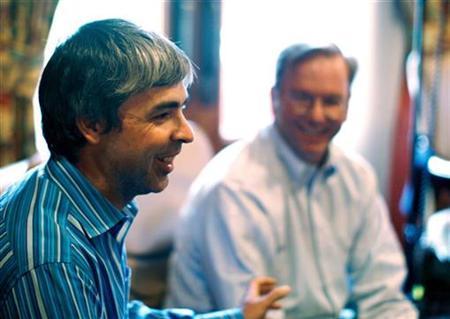
(Reuters) - Google Inc co-founder Larry Page will take over as CEO from Eric Schmidt, a surprise that signaled Silicon Valley's most powerful Internet company was taking the offensive against fast-moving rivals like Facebook.

Schmidt will step aside on April 4 and make way for Page -- who created the company with fellow Stanford University alumnus Sergey Brin in 1998 -- to take the reins of a company that has dominated Internet search for a decade but is in danger of losing traffic to social networks like Facebook and Twitter.

"Day-to-day adult supervision no longer needed!" Schmidt tweeted after the announcement.

Schmidt, who became CEO in 2001 to bring more management experience to a then-fledgling company, will assume the role of executive chairman, focusing on deals and government outreach, among other things. Brin will concentrate on strategic projects.

"Larry is ready. It's time for him to have a shot at running this," Schmidt told analysts on a conference call.

Shares in the Internet search and advertising leader rose about 2 percent to $639 in extended trading.

Just days ago, Apple Inc CEO Steve Jobs announced a leave of absence, leaving lieutenant Tim Cook in charge of day-to-day operations. Like Google, Apple also announced results this week that blew past Wall Street's estimates.

"The Street will think it's a negative, that there is probably some issue going on. Google is trying to get more efficient and trying to get a tech guy in the seat to compete with Facebook," said UBS analyst Brian Pitz. "I don't think it changes anything strategically where the company is headed."

News of the change came as Google reported a 29 percent surge in both net profit and net revenue that beat forecasts.

Net income, excluding items, of $8.75 a share outstripped Wall Street's average forecast of $8.10.

Net revenue, excluding fees paid to partner websites, was $6.37 billion. Analysts polled by Thomson Reuters I/B/E/S, on average, were expecting net revenue of $6.06 billion.

STREAMLINING

The world's top Internet company is recruiting and going on an acquisitions spree, aiming to ensure its online products remain popular as surfers turn to new services like Facebook -- now the most heavily trafficked website -- and wireless gadgets.

On a conference call with analysts, Google CFO Patrick Pichette said a 10 percent, across-the-board pay raise instituted late last year was a direct attempt to staunch a flow of talent to hot Web upstarts in the Valley.

Google tried to buy fast-growing online local-shopping service Groupon for $6 billion but was rebuffed, Chicago Breaking Business, a Tribune Newspaper website, and other news outlets reported.

The question is whether Facebook's success could start to cut into Google's business, as investors debate whether marketers will advertise on both online services, or shift advertising dollars from Google to the world's largest social network.

Google said the management change was made as part of a plan to "streamline" decision making and create clearer lines of responsibility and accountability at the top.

"It's a good move. It (the triumvirate management structure) was always one of things that concerned us a little bit," said Ryan Jacob, portfolio manager with the Jacob Internet Fund. "It should streamline the decision-making process. They're in a fast-moving industry."

Schmidt now plans to sell about 534,000 shares of Class A common stock, the company said. Based on Google's closing share price of $626.77 on Thursday, he would earn about $334.7 million on the stock sale. He would still own about 2.7 percent of Google's outstanding capital stock, down from 2.9 percent before selling the shares.

"As Google has grown, managing the business has become more complicated. So Larry, Sergey and I have been talking for a long time about how best to simplify our management structure and speed up decision making," Schmidt said in a posting on the company's official blog.

"And over the holidays we decided now was the right moment to make some changes to the way we are structured."

Google also reported fourth-quarter financial results, beating Wall Street's net revenue expectations.

Schmidt said on his blogpost that Page, the son of a Michigan State University computer science professor, will now lead product development and technology strategy, areas that are "his greatest strengths."

"It will be interesting to see what he'll do that's different, what he could not have done in his prior role," said BGC Partners analyst Colin Gillis

Sunday, January 16, 2011

Facebook, Google join web future warning

London, Jan 16 (ANI): Web addresses are likely to run out as soon as November and to raise public awareness Google and Facebook have decided to switch their websites to a new system for one day in June.

Buzz up!
On June 8, a whole bunch of web giants, including Google, Facebook, Yahoo, will turn on a new way of running web addresses, reports the Telegraph.


The system, called IPv6, has been designed to stop the world running out of the web addresses that underlie the locating of websites and devices.

As of now, only 0.2 per cent of web users have access to the new protocol, however. 'World IPv6' Day is designed to encourage its adoption.

Vint Cerf, one of the web's founding fathers, is leading a global campaign to encourage web service providers and IT managers to switch from the current system, IPv4, to IPv6.

The new standard offers many trillions of new web addresses, but cannot be accessed from modems and routers that only use IPv4.

It is likely, however, that most of the changes needed will take place without consumers losing access to any part of the web because they will be part of the standard software and hardware upgrade cycle.

The availability of new web addresses will, it is hoped, allow more connected devices, such as tablet computers, as well as permitting more mundane devices to gain web addresses.

Writing on the Google Blog, Network Engineer Lorenzo Colitti said, "Google has been supporting IPv6 since early 2008, when we first began offering search over IPv6. Since then we've brought IPv6 support to YouTube and have been helping ISPs enable Google over IPv6 by default for their users. On World IPv6 Day, we'll be taking the next big step. Together with major web companies such as Facebook and Yahoo!, we will enable IPv6 on our main websites for 24 hours."

He added, however that "Our current measurements suggest that the vast majority of users will be unaffected. However, in rare cases, users may experience connectivity problems, often due to misconfigured or misbehaving home network devices." (ANI)

Friday, January 14, 2011

Google unveils instant translation application on mobiles

Google has unveiled a mobile phone application that allows users to translate chats instantaneously.

Google Translate can use devices running its Android operating system to allow translation of English to Spanish and vice versa.

Users will have to punch a key to activate the translation between sentences, but Google expects the service to operate in real-time within 18 months.

It uses technology similar to the updated Googles application, which uses a phone's camera to snap images of sudoku puzzles and, via internet, whiz back the solution in seconds, the Daily Mail reports.

Google Translate works by recording the user's speech, sending the recorded words to the company's vast servers, which then send back an audio translation.

The 'Alpha' trial version works only in Spanish and English but Google expects to add new languages soon.

In December, an iPhone application called WordLens became an internet sensation after a video demonstrated how it uses the iPhone's inbuilt camera to recognise text that is viewed through the lens. It too only worked with Spanish and English.

Google already has an online text translator and while early versions of it sometimes produced little more than gobbledegook, it's ever-growing database of words has now enabled it to achieve far greater accuracy.

It now covers more than 52 of the world's estimated 6,000 languages.

As with automatic text translation, Google hopes the technique will become more sophisticated with the help of millions of users around the world.

But Google Translate is a giant leap forward in technology, eschewing text translations for direct speech, and it defies expert opinion.